
What to Eat Before a Workout: How to Choose Your Breakfast

Should you eat breakfast before a workout? There is no single answer for everyone. Some people feel fine doing a short session without eating; others prefer to have breakfast or a snack first. The length and intensity of your workout, your schedule, and how you feel can all help guide your choice.

What happens to insulin and energy?

After you eat, glucose and insulin change as part of the body’s normal response to food. Insulin helps regulate how the body uses and stores energy, but it does not work like a switch that completely turns off fat burning.

Not everyone experiences an energy dip or cravings after eating sugar, either. Your response may depend on the food, the amount, and what you eat with it. Pairing carbohydrates with protein or fiber may feel more satisfying for some people.

A meal can change which fuel the body uses for a period of time, but that change alone does not determine fat loss. In a four-week study, fasted training did not result in significantly greater fat loss than training after eating.
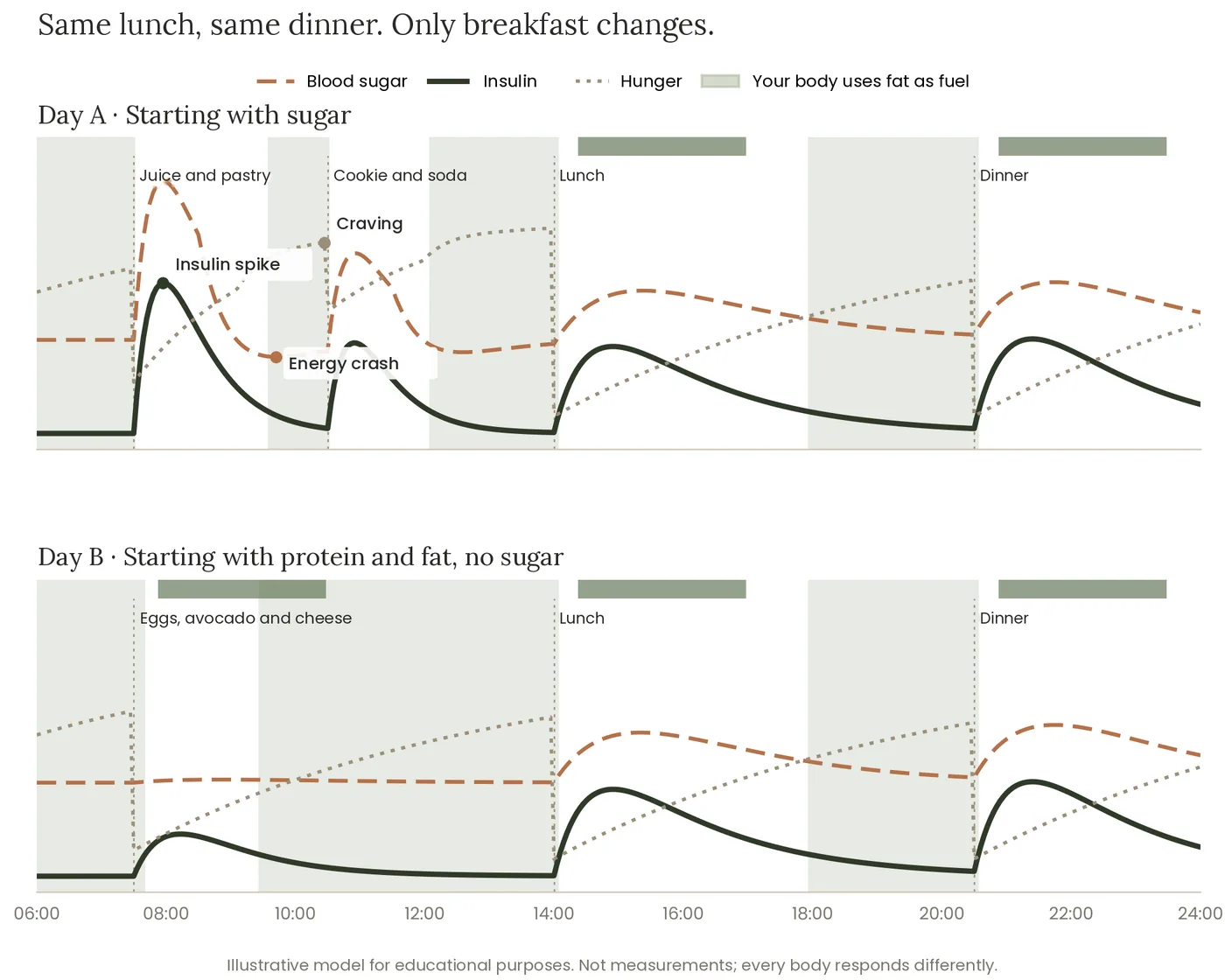
Illustrative chart comparing blood sugar, insulin and hunger over a day starting with a sugary breakfast versus a breakfast with protein and fat
Chart 1. Same lunch, same dinner. Only breakfast changes.

Do you need to eat fruit before a workout?

Not necessarily. Fruit provides carbohydrates and can be a practical pre-workout snack, but it is not a requirement for exercise. Many people can do a short or moderate workout without eating beforehand, as long as they feel comfortable.
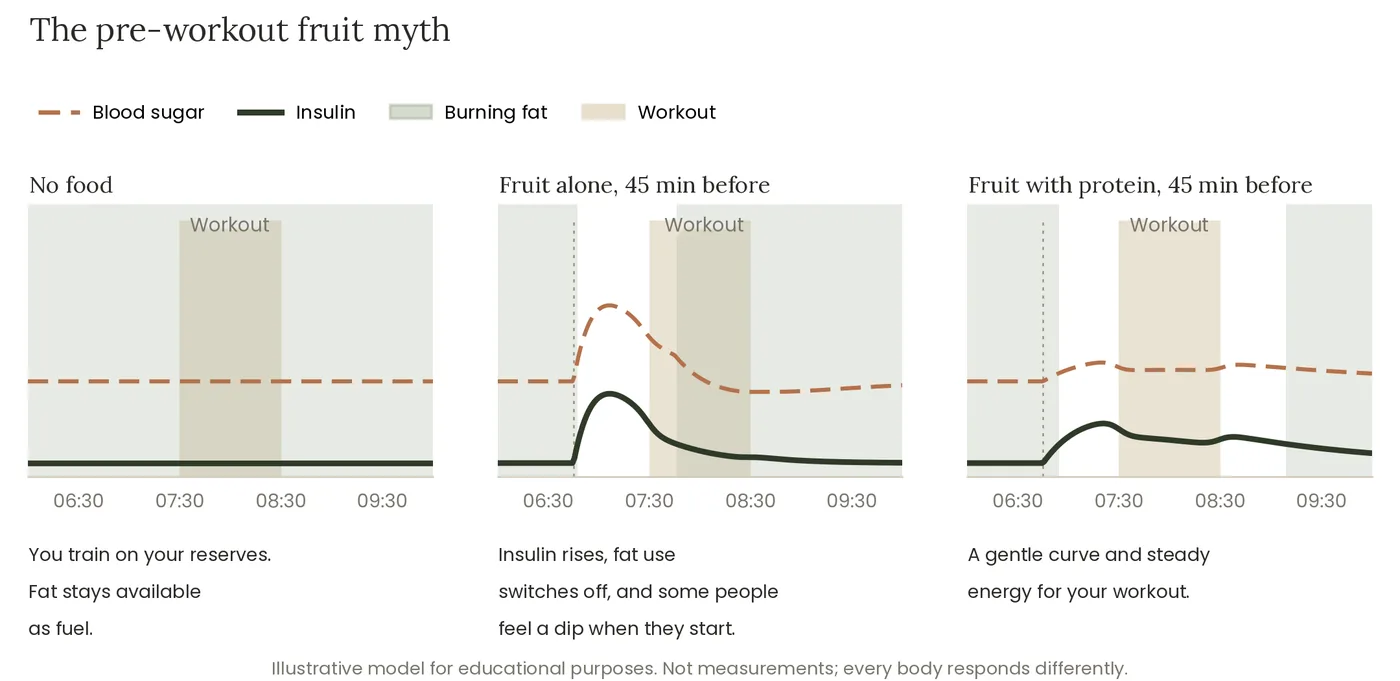
Illustrative chart comparing blood sugar and insulin before a workout with no food, fruit alone, or fruit with protein
Chart 2. Three ways to arrive at the same workout.

If you enjoy fruit before a workout, you can have it on its own or pair it with Greek yogurt, nuts, or another source of protein, depending on what feels best for you. There is no one required combination for everyone.

Using more fat as fuel during a workout does not automatically mean losing more body fat. Results depend on several factors over time, not on a single meal or morning.

What should you eat before or after a workout?

The six-morning graphic compares three breakfasts at two different times: before and after a workout. It can be a starting point for thinking about your options, but it does not mean one combination is universally better.
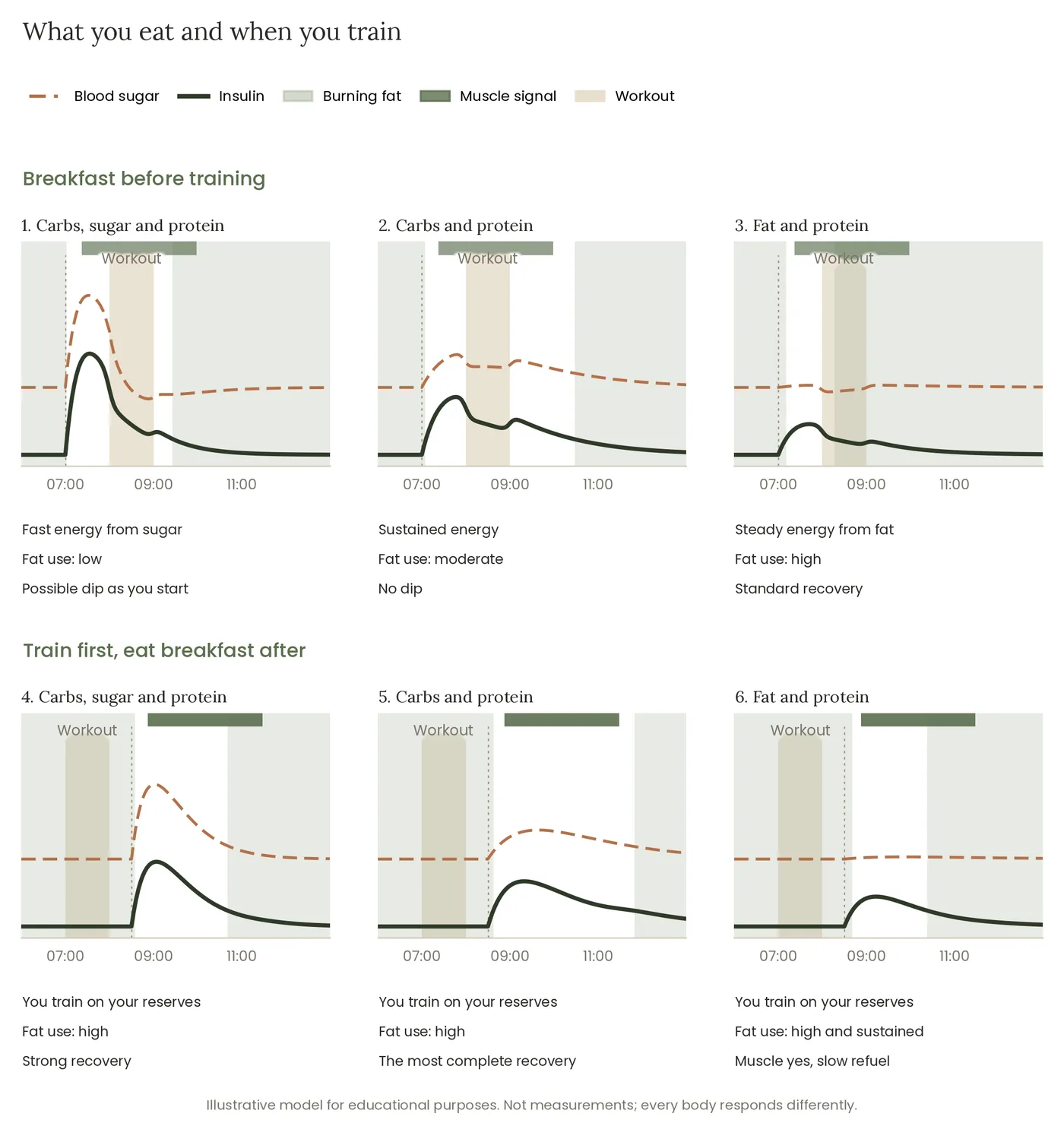
Illustrative chart of six mornings comparing three breakfasts eaten before or after training
Chart 3. Three breakfasts, before or after training.

If you prefer to eat before exercising, choose something you can digest comfortably that suits the demands of your session. If you train without breakfast, you can have your first meal afterward. Including protein and carbohydrates after exercise can be a practical way to support recovery, but there is no short time window that determines the entire outcome.

When can carbohydrates help?

Carbohydrates can be useful for long or demanding sessions, high-volume training, or days when you exercise more than once. They provide energy for your workout and help replenish some of what you have used.
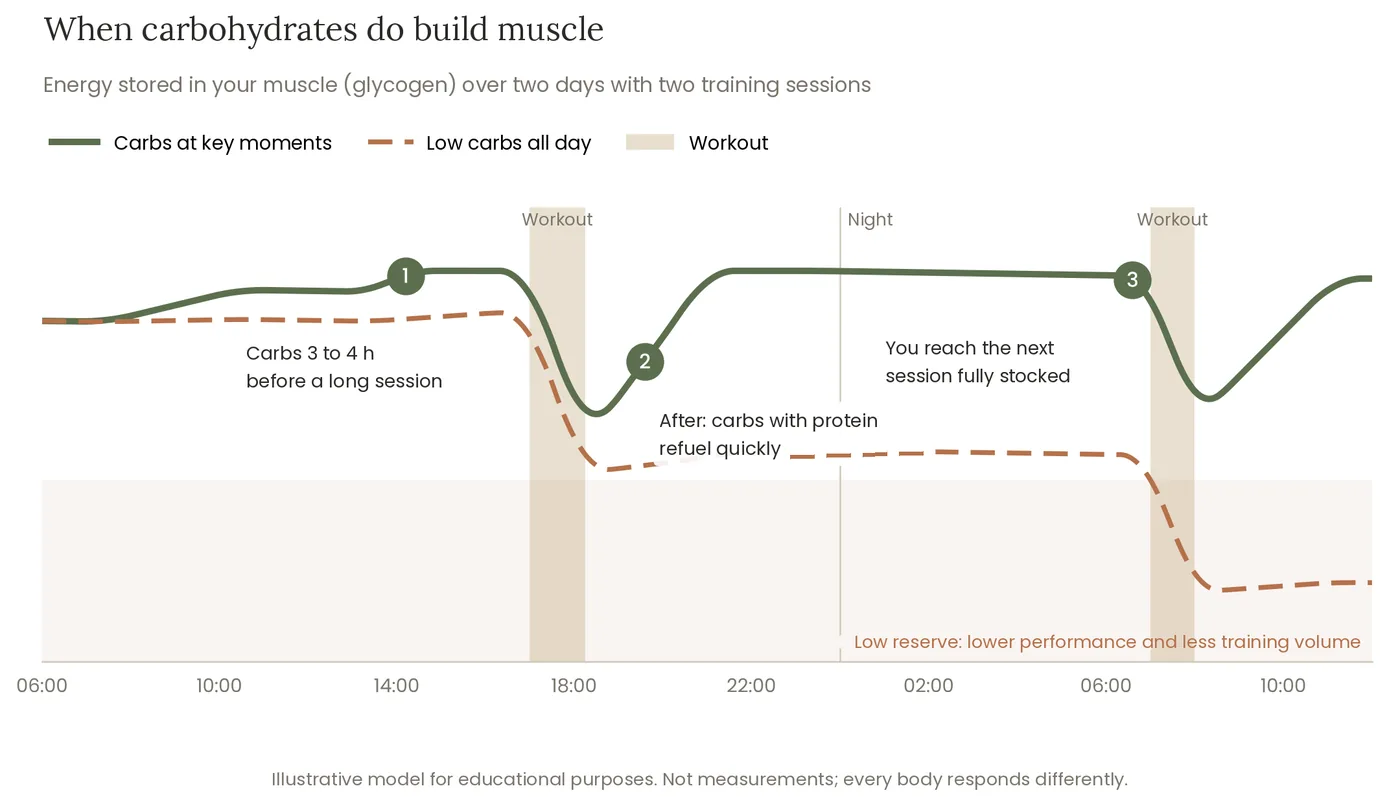
Illustrative chart of muscle glycogen over two days with carbs at key moments versus low carbs all day
Chart 4. Your muscle’s energy reserve with carbs at key moments vs. low carbs all day.

The amount and timing depend on the session and the individual. You do not need to eliminate carbohydrates or eat them at one exact time. Research on their effect on performance varies by exercise type and duration.

Carbohydrates do not build muscle on their own; they can help fuel your training. Exercise, overall nutrition, and recovery all play a part in the process.

Key takeaways

  • Not everyone needs breakfast before a workout.
  • Fruit can be an option, but it is not required.
  • If you eat carbohydrates, you can pair them with protein or fiber based on your preferences.
  • Carbohydrates can be especially useful for long or demanding sessions.
  • The best choice is one that suits your training and helps you stay consistent.

Your body, your data

These are general principles. Your response may vary based on your habits, sleep, stress, and training. At TEVA Wellness & Lifestyle in Polanco, the Body Blueprint helps take each person’s needs and characteristics into account when adjusting their protocol.

The question is not only what to eat, but what to eat, with what, and when.

This content is for educational purposes and does not replace personalized guidance from a healthcare or nutrition professional. The graphics are illustrative models and do not represent individual measurements.


I'd like to schedule a private tour Teva Wellness

Personal Trainer

Juan Sebastián Pulido

Sebastián specializes in strength training and sports performance, bringing his experience from the world of elite sport to every session at TEVA.

Originally from Bogotá, he studied in Miami and Mexico City, and holds a degree in Sports Science. His professional background includes being part of Anthony Joshua’s training team and serving as the personal trainer of Randy León, Mexico’s national boxing champion.

His method combines scientific knowledge with the discipline, precision, and high standards of professional athletic training. Sebastián adapts these principles to each person’s fitness level and goals, whether they’re looking to build strength, improve performance, or feel more capable and confident in their body.

His sessions are structured, focused, and demanding. He’s an excellent choice for those seeking measurable results who enjoy working with a coach who pushes them with intention and purpose.

Specialties

Strength training

Sports performance

Physical conditioning

Boxing-based training

Operations and Performance Manager

Daniel Peralta Delgado

Behind every great training experience is someone setting the standard. At TEVA, that person is Daniel.

Daniel leads Operations and Performance, bringing experience from prestigious fitness clubs across Colombia, Australia and Canada. He holds a master’s degree in Fitness and Health Promotion and has trained in strength, endurance, nutrition, sleep and leadership. He works closely with TEVA’s trainers to develop their skills and ensure members receive knowledgeable guidance shaped around their individual goals.

His understanding of the body is personal as well as professional. After an illness left him in bed for six months, Daniel had to rebuild his own strength. That experience changed how he sees fitness: what your body can do matters more than how it looks.

He has since completed six Ironman 70.3 races, eleven marathons and twenty-three half marathons. Daniel knows what it takes to pursue an ambitious goal, and he knows that progress depends on consistency, a thoughtful plan and the right balance between training and recovery.

TEVA members have direct access to Daniel’s expertise when they are considering a challenge such as an Ironman, marathon or HYROX. He can help them assess where they are now and develop a personalised performance strategy around their ability, schedule and goals. It is an opportunity to plan with someone who has lived the preparation, the setbacks and the finish lines himself.

You do not need to be an endurance athlete to benefit from his leadership. Whether your goal is to build strength, return to exercise or feel more capable in your body, Daniel helps ensure the team supporting you has the knowledge and care to help you move forward.

Education

  • Master’s in Fitness and Health Promotion, Toronto, Canada
  • Bachelor’s degree in Ecology, Pontificia Universidad Javeriana, Bogotá, Colombia

Training and performance certifications

  • UESCA Running Coach
  • DTS Barbell Strength
  • DTS Sleep Coach Specialist
  • ECEP Personal Trainer, ACSM validated
  • 100-hour yoga training, Rishikesh, India

Nutrition and health certifications

  • IFBB Sports Nutrition
  • NASM Nutrition Coach
  • NASM Personal Trainer
  • NASM Online Coach

Leadership development

  • Crucial Conversations for Mastering Dialogue, Crucial Learning

Athletic achievements

  • 6 Ironman 70.3 races
  • 11 marathons
  • 23 half marathons

Specialties

Operations & program design

Sports science

Athlete development

Strength & conditioning

Personal Trainer

Jocabed Carranza

Joca specializes in strength training and hypertrophy, holds professional training certification from CONADE, and has a particular focus on training for women.

Her method is designed to build muscle strategically, focusing on the areas that help create a stronger, more defined, and proportioned figure. She’s especially known for helping her clients build glutes and strengthen the lower body.

Joca is strict, demanding, and very clear with her clients, but she also knows exactly how to motivate them when they start doubting themselves. She’ll eliminate every excuse, hold you accountable for your decisions, and keep a bad day from turning into giving up on your goal.

Her commitment goes far beyond running a session. Joca constantly supports, corrects, and pushes every client. She’ll celebrate your progress, but she won’t let you settle for less than she knows you can achieve.

She’s an excellent choice for women who want to build muscle, transform their figure, and work with a coach who keeps them focused on getting visible results.

Specialties

Strength training

Hypertrophy training

Training for women

Glute development, muscle mass gain, and body transformation

Physical Therapist

Amaya Mantilla

Amaya is a physical therapist specializing in physical medicine and rehabilitation. Her expertise allows her to design highly personalized training programs for people with current injuries, a history of injuries, or physical limitations, helping them build strength without ignoring what their body needs.

For three years, Amaya was the “secret weapon” behind the most elite division of the Navy, making sure its members stayed in peak physical condition at all times. In an environment where the body must perform at the highest level, she combined injury prevention, rehabilitation, and physical preparation to keep them ready for any challenge.

Today she applies that same precision and attention to every client at TEVA. Amaya knows when to challenge the body, when to modify a movement, and how to build strength without letting an injury define the entire training experience.

Her sweet, gentle appearance can be deceiving. Behind it is a demanding, highly observant professional who will take care of you — but will also make you work.

She’s an excellent choice for those looking to regain confidence in their body, return to training after an injury, or follow a program designed specifically for their physical condition.

Specialties

Physical therapy

Physical medicine and rehabilitation

Injury prevention

Functional recovery and adapted training

Personal Trainer

Juan Sebastián Pulido

Sebastián specializes in strength training and sports performance, bringing his experience from the world of elite sport to every session at TEVA.

Originally from Bogotá, he studied in Miami and Mexico City, and holds a degree in Sports Science. His professional background includes being part of Anthony Joshua’s training team and serving as the personal trainer of Randy León, Mexico’s national boxing champion.

His method combines scientific knowledge with the discipline, precision, and high standards of professional athletic training. Sebastián adapts these principles to each person’s fitness level and goals, whether they’re looking to build strength, improve performance, or feel more capable and confident in their body.

His sessions are structured, focused, and demanding. He’s an excellent choice for those seeking measurable results who enjoy working with a coach who pushes them with intention and purpose.

Specialties

Strength training

Sports performance

Physical conditioning

Boxing-based training